
The right braking habits, the gear that changes everything, and the maintenance that keeps rust away.

In short: riding in the rain calls for three adjustments: brake earlier and more gradually, lower your tire pressure slightly for better grip, and rinse then lubricate the chain when you get home. Rain does not damage your bike; the water sitting on it afterwards does.
For a regular cyclist, a bit of rain should not take away the joy of riding. Wet pavement changes the rules, but with the right habits and the right gear, it is just another ride. Here is what actually matters.
In this article
1. Adapting your riding style
Riding wet means changing how you ride. The principle is simple: anticipate rather than react. Look far ahead, spot the trouble spots, and give yourself more room for anything that might happen.
The surfaces to really watch: dead leaves, white crosswalk stripes, manhole covers and tramway tracks. All of them turn slippery the moment they are wet, and none of them show up if you are staring at your front wheel.
2. Mastering the brakes
Braking in the rain takes finesse. Hard braking on wet pavement means a fall. Brake gradually, start early, and share the work between both brakes instead of asking everything of one.
On a bike, avoid leaning too hard on the front brake alone: it is the one that lifts the rear wheel and sends the handlebars sideways. On a descent, brake before you get there, not on the way down. And keep a relaxed posture with soft arms: a tense rider transmits every vibration straight to the wheel.
The detail that changes everything: brake pads made for wet conditions. They bite better on a wet rim and wear more slowly than standard pads. It is one of the few purchases where the "rain" version is felt on the very first ride.
3. Tires, pressure and fenders
Tires. Grip comes before everything else. All-season tires built for traction make a real difference on wet pavement. And contrary to intuition, you lower the pressure slightly in the rain: a slightly softer tire hugs the road and keeps better contact.
Be careful not to overdo it in the other direction. A tire that is too soft pinches against the rim and guarantees a flat. Keep enough pressure to protect the rim, and no more. If you are unsure of the right value for your model, stop by a store: we set it for free.
Fenders. They are your main protection against water spray. Our stores carry every style, for every bike. Without fenders you ride with a stripe of water up your back and onto your legs, and you throw it at pedestrians and other riders too.
4. Gearing up to stay dry
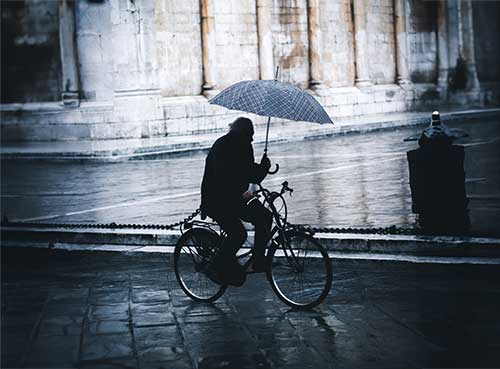
Good rain gear is what turns a miserable ride into a normal one:
A waterproof, breathable jacket. Breathable matters as much as waterproof: a jacket that traps vapour soaks you from the inside within ten minutes of effort.
Rain pants and shoe covers, or waterproof shoes. Wet feet ruin a ride more reliably than the rain itself.
Waterproof gloves to keep your hands dry and your braking precise.
Visibility. In the rain the light drops and windshields fog up. Something reflective or high-vis, plus working lights, is not comfort: it is your safety.
And pack spare clothes if you are commuting. Arriving at the office dry changes your whole day.
5. Post-ride maintenance

This is the step everyone skips, and it is the one that decides whether your bike lasts ten years or three. The water sitting on the parts is what damages them, not the rain during the ride.
When you get home, rinse the bike, focusing on the chain and brakes: mud and road salt are abrasive. Then dry and lubricate the chain with a wet-weather lube. A wet, unlubricated chain rusts overnight, and a rusty chain wears out your chainring and cassette along with it.
6. E-bikes and e-scooters: the extra precautions
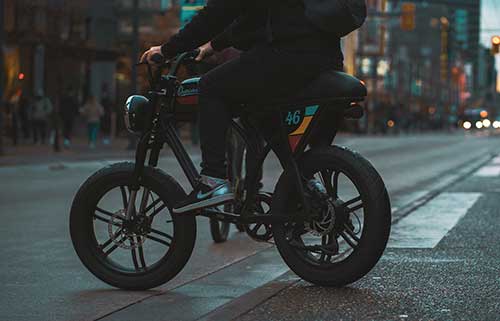
Riding electric in the rain takes a few extra precautions:
Braking. Keep a balance between front and rear brakes, and adjust your speed. An e-bike is heavier and faster than a standard bike: stopping distance on wet pavement is not the same.
Protect the electronics. Battery, display, saddle: invest in waterproof covers. These parts are expensive and they do not like water.
Your scooter's water resistance rating. Check its IP (Ingress Protection) rating: that is what tells you how much rain your model handles. An IPX4 rating does not mean the same thing as an IPX6.
Dry it after every ride. Wipe the scooter down when you get home, focusing on the display and under the deck. A clean rag on the brake rotors keeps them from oxidising.
Avoid heavy rain, seriously
Most scooters are not designed for sustained downpours. If you get caught in one, avoid puddles and anything that could submerge the machine. A scooter that takes on water at the deck or the motor is not a cleaning job: it is a replacement.
Light rain is not a problem. Heavy rain is.
7. Flat tires: why rain makes them more frequent
Rain washes the road and concentrates small debris where the water flows. Those shards stick to the tire, work their way in, then pierce the rubber and the tube. It is mechanical: it rains, and flats go up.
Two habits cut the risk sharply:
Watch the road. Avoid dirty patches, puddles and glass when you can. Debris you avoid cannot puncture.
Clean your tires when you get home. A rag to remove the visible sharp bits, and you avoid the next ride's flat. It takes thirty seconds.
One look at the weather before you leave. A real-time rain detection app, like the Weather Network assistant or Radar, lets you slot your ride between two showers. It is the kind of detail that turns a wet ride into a dry one.
In conclusion
Light rain is generally not a problem: at normal speed you dry off fast enough to barely feel the moisture. With everything above, you are ready for heavier rain.
What we do advise against is riding in genuinely bad conditions. No technique makes up for a storm. For everything else, you now have what you need to ride in the rain with confidence.
Sources
- · IP (Ingress Protection) ratings: IEC 60529 standard, defining dust and water resistance for electronic devices.
- · Repair and Run workshop data: spike in flat tires observed in wet weather, 2026.
On our blog
- → How to avoid E-Scooter flatWhy a soft tire goes flat more often, and how to stop it.
- → 7 fall riding hacks: safety and maintenanceThe seasonal checks that prevent breakdowns.
At Repair and Run
- → Electric scooter repairFlats, brakes, electrical diagnostics: our dedicated page.
- → Repair and maintenanceOur full service list and pricing.
- → Our pumps and accessoriesGauge pumps and valve extensions.
- → Fleet and on-site maintenanceRunning a bike fleet? We come to you.